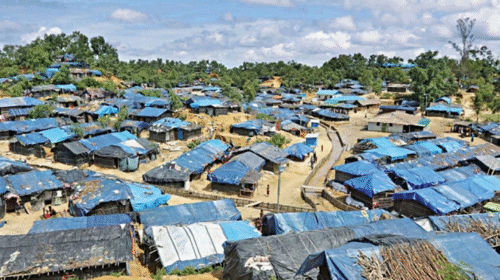




Khagrachari Correspondent: Rangamati in the hill district, the military regime of the then dictator Ershad Sarkar, 04 May Longadu Genocide Day. This murder has not been tried in 34 years. The victims are still living inhumane lives.
On 21 May 1989, the Greater Chittagong Hill Tracts Student Parishad held its first silent march in Dhaka to protest the Longadu Genocide. 04 May 2023 marks 34 years of Longadu massacre. On this day (04 May) in 1989, in Longdu upazila of Rangamati, Bengalis with the help of Army and Village Defense Force (VDP) controlled by the then Ershad government carried out this planned massacre in hilly villages. Many mountaineers were killed in this. Communal settlers of the fundamentalist Jamaat burnt the houses of Paharis, destroyed Buddhist temples and Buddha statues. But even today there has been no trial for this massacre.
According to Amnesty International’s report, two and a half hours after the then Langadu Upazila Chairman Abdur Rashid Sarkar was shot dead near his office at around 4-5 pm on May 4, 1989, revenge attacks on the hill villagers in Longadu began. At least 36 men, women and children died in this revenge attack. However, the actual death toll may be higher, the report said. And although the peacekeeping force was blamed for the death of Abdur Rashid Sarkar, Amnesty International could not find any reason for it, the report said.
According to Amnesty’s report, “at least six villages were attacked, hundreds of mountain houses, numerous Buddhist temples and two Christian churches were burnt down. Those who survived fled to the hills and forests for shelter and a large number of them crossed the border and took refuge in refugee camps in the Indian state of Tripura.”
At that time, Chakma Raja Barrister Debashish Roy, former Member of Parliament Chaithwai Roaja, former Member of Parliament Sudipta Dewan, former advisor to the President Subimal Dewan, then Chairman of Rangamati Local Government Parishad Gautam Dewan and Rangamati Sadar Upazila Chairman Mayadhan Chakma, 22 prominent hill leaders were investigated by the judicial department. Rangamati submitted a memorandum to the District Commissioner.
In the memorandum, they described the horror of the massacre and said, “Despite all the security arrangements at the upazila headquarters, Anil Bihari Chakma, member of Parbatya Zilla Parishad (local government council), former chairman of Longadu Union Parishad and headman of No. 3 Longadu Mauza, Anil Bihari Chakma was attacked at his residence. Luckily he survived, but his wife and many of his neighbors (who had taken refuge in the headman’s residence) were brutally murdered. The killers did not stop killing these innocent women, men and children with firearms including Da, Ballam etc. The dead bodies were dumped in the house and set on fire. Anil Bihari Chakma took his wife’s dead body out of the house and kept it guarded all night in the forest near the house. When they came to the police station in the early morning to rescue them, they did not find any trace of the dead body. Due to the horror of the situation, the dead bodies could not be cremated even according to religious rules.” (Source: Radar, Logang Massacre Number).
At the time when this incident took place, the country was under military rule under the Ershad government. The dictator Ershad was in the seat of power. As a result, the news of this Babar massacre was not published or allowed to be published in any newspaper of Bangladesh at that time.
Greater Chittagong Hill Tracts Student Council was born on 20 May 1989 out of protest against this genocide.
Pahari Chhatra Parishad took out a silent procession on the streets of Dhaka on May 21, 1989 and organized a protest meeting in front of the National Press Club to officially protest the horrific massacre. In this, the leaders of Pahari Chhatra Parishad strongly condemned this barbaric massacre and demanded compensation for the affected families along with publication of a white paper through judicial inquiry and punishment of the culprits. On May 30, 1989, Buddhist monks staged a silent protest in Dhaka to protest this barbaric massacre.
But despite the change of power in the country for a long 34 years, no government has taken any kind of punitive action against those involved in the trial of this genocide. Not only that, there has been no trial for more than a dozen massacres in the Chittagong Hill Tracts. Even the proper investigation report of these massacres has not been published till date.
Due to the non-trial of these massacres in the Chittagong Hill Tracts, the hill people are repeatedly subjected to communal attacks. Such barbaric attacks did not stop even after the Mountain Accord. Rather, it can be said that more communal attacks have taken place in Chittagong Hill Tracts than before the agreement.
On June 2, 2017, a barbaric sectarian attack was again carried out on Paharis in Longdu, which witnessed the massacre. Settlers, with the help of the army and the administration, attacked several villages of the hills and burnt more than two hundred houses to ashes, and burnt to death a 70-year-old old woman. Earlier in 2011 too, a communal attack was carried out on Paharis in Langadu in the same incident. At that time many houses were burnt.
The government as well as the state should publish a white paper on all the massacres committed against hillbillies in Chittagong Hill Tracts including the Longadu massacre and take the initiative of proper trial. It should be remembered that people will continue to demand justice for these massacres until there is no trial.