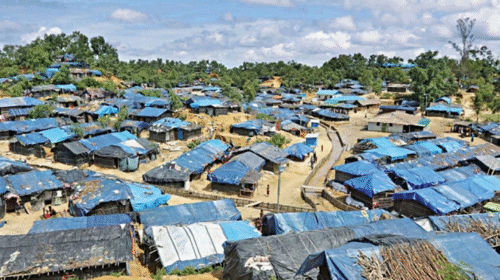




The Crime Desk: The money is not meeting the promises of the rich donor countries in support of the Rohingyas, who have been forcibly displaced from Myanmar and have taken shelter in Bangladesh. The World Food Program (WFP) has reduced its monthly food aid from $10 per person to $8 this month due to a funding crunch. This organization of the United Nations has said that Bangladesh has to fill this shortage of food aid. Bangladesh strongly objected to this. WFP has been informed by Bangladesh that the responsibility of raising the Rohingyas lies with the international community, not Bangladesh. The amount of food aid cannot be reduced in any way but must be increased.
Meanwhile, concerned officials fear that due to the reduction of food aid to the Rohingyas, unrest and chaos will increase in the shelter camps. According to them, drug and arms smuggling and anti-social activities will increase. Lack of food will create an anarchic situation in the camp.
Disaster Management and Relief Secretary Kamrul Hasan confirmed the truth of the matter. He told the media in his office last Thursday, “WFP has reduced the monthly food aid to the Rohingyas.” Bangladesh has been asked to meet the deficit in aid. We did not agree to that. I told them in a letter that the responsibility for supporting the Rohingyas is not Bangladesh’s but of the world community. Food aid should not be reduced but should be increased.
The top officials of the government are meeting at the Prime Minister’s office tomorrow at 3 p.m. to determine what to do in the situation. Chief Secretary of the Prime Minister’s Office Tofazzal Hossain Mia presided over this meeting on the overall management and humanitarian assistance activities of ‘Forcibly Displaced Myanmar Citizens’. The Public Security Department, the Ministry of Disaster Management and Relief, and concerned officials, including the Secretary of the Prime Minister’s Office, will be present. Ambassadors, High Commissioners, and representatives of relevant UN agencies have also been asked to attend.
It is known that since the Rohingya started coming to Bangladesh from Myanmar in 2017, WFP has been providing them with food, nutrition, and other urgent assistance. This emergency assistance is being provided with the help of donor groups and partner organizations. Currently, there are about 1 million Rohingyas registered in Bangladesh, but in reality, this number is over 11 million. All are being given food assistance equivalent to USD 12 per month through vouchers. Using these vouchers, Rohingya families can choose food from WFP outlets located in all camps. The United Nations is struggling to deliver food to vulnerable populations due to rising food prices on the global market as well as funding shortfalls due to the impact of the COVID pandemic and the Russia-Ukraine war.
WFP is cutting food aid in various countries, including Palestine, Iraq, Syria, and Afghanistan. Similarly, last March, WFP’s food aid amount of $12 was reduced to $10. For the first time in nearly six years since the Rohingya crisis, the agency has reduced aid to Rohingyas in Cox’s Bazar. After just three months, it is being reduced from $10 to $8 again on June 1 for the same reason. Through this, 33 percent of the Rohingya’s daily ration will be reduced. That is, each Rohingya will be given food vouchers worth only 8 dollars (Tk 840) every month.
Prime Minister Sheikh Hasina said in an interview given to NHK television during her recent visit to Japan, “It is becoming difficult to run Rohingya camps in Bangladesh due to the increase in fuel and food costs.”
The United Nations cut food aid to the Rohingya by 17 percent last March due to funding shortages. UN Special Rapporteur on the human rights situation in Myanmar, Tom Andrews, warned on April 28: “If funds are not received, food aid will be cut by another 20 percent in the next few weeks.”
When asked about this, Refugee Relief and Repatriation Commissioner and Additional Secretary Mohammad Mizanur Rahman, assigned to Cox’s Bazar, told the media, “The Rohingyas in the camp will suffer severe malnutrition.” Anger and frustration will arise in them. Their reckless behavior will increase. Discontent and anarchy will increase with fights and murders. Anti-social activities will multiply in the camps, along with the drug and arms trade. It will be very difficult to control them.