


The Crime Desk: The Telecommunication Regulatory Commission (BTRC) has said ‘no’ to the proposal to take bandwidth to the seven northeastern states of India, i.e., the Seven Sisters, by transiting Bangladesh. The country’s two International Telespatial Cable (ITC) companies, Summit Communications and Fiber at Home, had taken this initiative in collaboration with Indian telecom operator Bharti Airtel. The decision to grant approval was almost final during the previous government. However, the BTRC did not approve the proposal at the last minute.
BTRC Chairman Major General (Retd) Ershad ul Bari told Ittefaq, “We have rejected the application that we had. Because according to the existing laws and rules of Bangladesh, there is no chance for them to approve this proposal. Along with this, we have also canceled the letter sent to the Telecommunication Department.”
Earlier, Bharti Airtel had applied to the Ministry of Foreign Affairs of Bangladesh during the previous government. The Ministry of External Affairs sent it to the Department of Telecommunications to take action. The Department of Telecommunications sent it to the BTRC. This time, the BTRC has directly rejected this decision. At the same time, the BTRC has also canceled the letter sent to the Department of Telecommunications to allow transit.
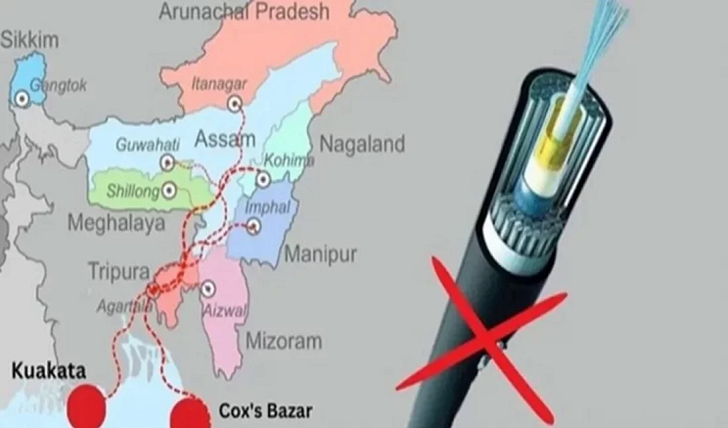
How this transit was planned: The northeastern states of India—Tripura, Mizoram, Manipur, Arunachal Pradesh, Assam, Nagaland, and Meghalaya—are known as the Seven Sisters. This initiative to launch International Private Leased Circuit (IPLC) services with Bharti Airtel to provide high-speed internet in these Seven Sisters. The land of Bangladesh will be used as the transit route. This connection was supposed to be made between Summit, Fiber at Home, and Bharti Airtel through interconnection points in Brahmanbaria, Akhaura, and Noman’s Land in Agartala, India. Summit and Fiber at Home would set up a Terrestrial Cable Landing Station (TCLS) at the Akhaura border. From this TCLS, fiber would be connected to the submarine cable landing stations of the Bangladesh Submarine Cable Company in Cox’s Bazar and Kuakata. Through which this IPLC service would be extended to Singapore.
The distance from the Seven Sisters in India to the landing station of the Chennai submarine cable is 5,500 kilometers. The distance from Singapore in India to the current network is 8,700 kilometers. Since the area along the Seven Sisters route is inaccessible, it is quite difficult to maintain the fiber network, create new networks, and maintain the network. And due to the long distance, the latency is 55 milliseconds, which reaches 87 milliseconds to Singapore. The cost also increases. As a result, providing quality service is challenging. On the other hand, the distance through Bangladesh will be reduced by 3,700 kilometers due to this transit network, and the latency to Singapore will be reduced by 37 milliseconds.
The arguments given by BTRC: A BTRC source said that Bangladesh’s position as a regional hub will be weakened due to the transit, and India will be established as a strong hub here. They say that there has been no initial discussion between Bangladesh and India about IPLC transit. Naturally, there are questions about its rationality, legal and commercial reality, geopolitical context, and transparency. In addition, since the edge POPs of companies like Google, Akamai, Amazon, and Meta are in Kolkata, Mumbai, and Chennai in India, Indian telecom operators will be able to provide easy and fast internet to the Seven Sisters through IPLC transit. This will challenge the possibility of these companies setting up edge POPs and data centers in Bangladesh and providing bandwidth export-internet services to the Seven Sisters, northwest China, and Myanmar. They could have taken this opportunity from Bangladesh if they wanted. What they wanted to do with Summit or Fiber at Home transit cables was illegal.
International Internet Gateway Association Bangladesh (IIGAB) President Aminul Hakim told the media, “Bangladesh would not have benefited from this transit. The two ITC operators would have benefited. They would have strategically reached an understanding where there would be no transaction regarding the purchase of bandwidth from India as ITC and no transaction regarding this transit charge. As a result, the government would have lost huge revenue.”