


The Crime Desk: The main spirit of the mass uprising of 24 was the desire to create an inclusive state free from discrimination. Which is never possible without excluding more than 50 percent of the population of women.
This movement was successful not only because of men but also because of the presence of women. The women who directly led and participated in the movement believe that the women who played a role in this movement have been successfully cornered.
If the post-uprising state becomes the representative of citizens of a particular gender, a particular class, or a particular ethnic and religious identity, then it will be a betrayal of the blood of the martyrs and the injured.
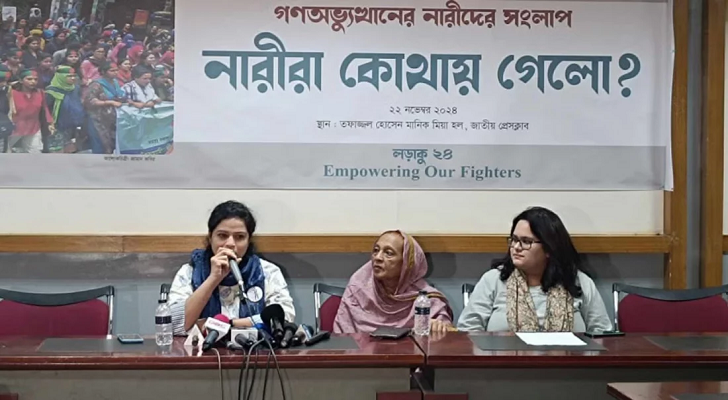
They said these things at a discussion titled ‘Dialogue of Women in the Mass Uprising: Where Have the Women Went’ at the National Press Club on Friday (November 22).
Participants in the discussion organized by the voluntary organizations Ladaku 24 and Empowering Our Fighters said that the culture of denying the role of women and depriving them in all areas in the past still continues.
Nazifa Jannat, one of the coordinators of the student movement in July-August and a student of East West University, said, “It is very sad that at this time, women have to say that we were also in the movement. Now I am asked, Where are you now? The question should actually be asked to those political parties that have the capacity, why women were not included.”
She said, “Women are not represented in the power dynamics, and it needs to be increased. Women should not go and say about the role of women. The state has to acknowledge this.”
“In the past, we were victims of discrimination, so we protested to eliminate all forms of discrimination,” added Nazifa.
Umama Fatema, spokesperson for the anti-discrimination student movement, said, “After so long of a movement, it is clear that there has been a successful attempt to corner the girls. When the boys were being detained, we girls led the way. But after August 5, I completely vanished. The attempt to make the boys heroes started, and I started suffering from an identity crisis.”
She added, “At first, I thought it was just me. But all the female students who have participated in the movement across the country have had the same experience.”
“Not only that, those who led the movement were targeted and harassed on social media. But no action was taken. Because of which women have also been cornered,” said Umama.
Arthi Zukhrif, a doctor who provided medical care to about 100 people injured in the July-August movement by organizing medical camps, said, “The presence of women in the Reform Commission is relatively low. We believe that women should be present equally here; there should be no discrimination.’
Describing the time of providing medical care, he said that he provided services to the injured out of a sense of professional and social responsibility. The women he knew at that time helped him in any way they could.
Journalist Shamima Sultana Lavu, who was injured during the movement, said, ‘Common people do not know that field journalists have no role in all media decisions. The then press secretary went to the office and monitored.
Our channel was also temporarily closed. But we did not stop. We provided the footage that we could not air to foreign media.’
He said, ‘Many people identify the media as brokers. But their number is very insignificant. But all the blame falls on all the journalists, and they are facing the wrath of the people.’
Jannatul Ferdous Neetu, a second-year student of Barisal Government College who participated in the movement in Barisal, said, ‘Despite the equal role of women in the movement along with men, there is an attempt to marginalize women after the movement. No female students have been placed in the advisory council.
Although a female student was placed as a spokesperson in the main committee of the anti-discrimination movement, we do not see her in press releases or other activities, which is very disappointing.’
Samia Akhter Jannat, a class 10 student from Kamrangirchar area who was injured several times in the movement, said, ‘Far from properly acknowledging the role of women in the uprising, they are being further excluded, which is basically giving rise to discrimination.’
Sabina Yasmin, a female worker who participated in the movement in Ashulia, said, ‘Many people say that the students’ movement was a mass uprising. But along with the working class, women workers also participated spontaneously, and many women were injured and killed, which is still not being properly evaluated.’
Sabrina Akhter, a student of Begum Rokeya University, said, ‘From the beginning of the movement, girls had a role like boys. But the discrimination against women, like in the past, still continues.’
The dialogue was inaugurated by Ainun Nahar, the mother of Naima Sultana, a student who was killed in the mass uprising. Reminiscing about her daughter, she said, ‘We left the village for the city for our daughter’s education.’
But all our family’s dreams have been shattered with her death. She was with the anti-discrimination movement from the beginning. She had many arguments with me when I forbade her to go.’
She wants the stories of the martyrs in July-August to be included in the textbooks, as well as the maximum punishment for those involved in the killings and proper evaluation of the victims.