


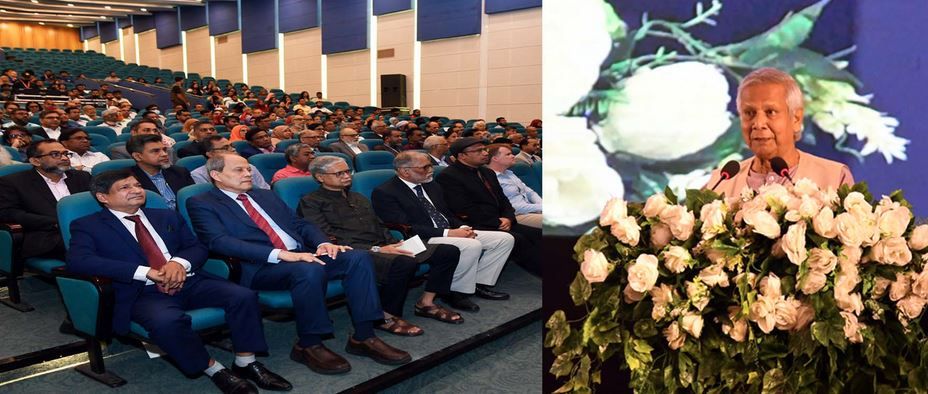
Dhaka Bureau: Through the July-August revolution, the student-teacher community has regained their freedom of thought and the practice of free intellect. Speaking at the opening ceremony of the conference entitled ‘Bose-Einstein Statistics Centenary Celebration: Dhaka’s Legacy’, today Thursday (07 November) in Dhaka, Chief Adviser to the Interim Government Professor Dr. Muhammad Yunus said this.
The Physics Department of Dhaka University and the Center for Advanced Study and Research in Natural Sciences, DU have jointly organized this two-day festival. He said, to this must be added the ability to contribute to world science. It will be achieved through daily reading and research keeping the aspiration high.
Muhammad Yunus said, our interim government is the product of revolution. So we are ready to take all necessary reforms and all efforts to create suitable environment to contribute to world-science. Demands, suggestions should come from all those dedicated to this work. We can do this if we have faith in ourselves – like the faith Satyendranath Bose had when he was able to write to Einstein despite being a complete stranger.
He said that the atmosphere of Satyendranath Bose’s discovery in 1924 will continue to develop in the same way. There is no alternative. We have to inculcate in the minds of the youth that we are the world. Today we are celebrating the centenary of that aspiration. Referring to scientist Satyendranath Bose as the brightest star in the history of Bangladesh, Professor Yunus said, today we have come to celebrate the centenary of the greatest contribution of one of the brightest stars in the history of our country and university.
Who in 1924 became part of science history for his discovery of Bose-Einstein quantum statistics. And he did it as a young professor at our Dhaka University sitting in a room in Curzon Hall, which today is bustling with physics student-teachers.
Dr. Yunus said, because of the importance of his discovery, physicists from different countries of the world are celebrating this centenary. But for us the meaning of this discovery is different. Physicists say it was a major addition to the quantum theory that revolutionized physics at that point in the 20th century. Through this, Bose brilliantly marked our university, our city of Dhaka on the world-science map.
Professor Yunus said, today, when we are trying to rebuild the country through an all-round revolution of the students, we want to restore the university to its proper place of practice, then what can be more appropriate than this centenary of Bose’s discovery to celebrate as a visionary of change? What else can be a motivation for the heroes of our revolution or a greater memory of glory? He said, I have left the year 1924 far behind. Has Bose’s discovery faded over time? Physicists say not at all. The Bose-Einstein Condensate was awarded the Nobel Prize in Physics in 2001 for proof of this discovery. Research on this is ongoing. He pointed out that students of physics all over the world know that fundamental particles are at the very root of all matter and energy, and that fundamental particles play a major role in their classification, with Bose’s theory as the guide.
The Chief Adviser said, Satyendranath Bose is arguing for the introduction of Bengali language at all levels of education, especially in higher science education, writing books in Bengali, publishing magazines, using Bengali in his teaching. Literary lovers of the city have established regular meetings with some of the culture lovers. In the fifties, the Nobel laureate Dr. Yunus said, when I was a student of Dhaka University in the late fifties, Basu’s Dhaka was more similar to Dhaka. So I can imagine the atmosphere, of Dhaka and Dhaka University. That quiet little town, that green Ramana can’t be brought back, but we can definitely bring back that glorious Dhaka University, in today’s independent Bangladesh. We want to emphasize this on the centenary of Bose-Einstein theory.