


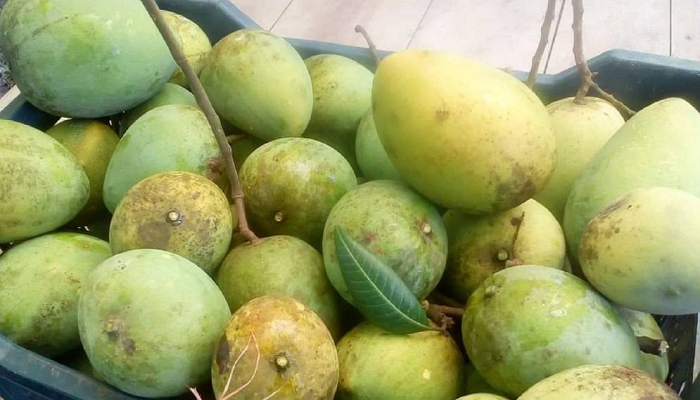
Dhaka Bureau: Garden owners and farmers are expecting a bumper crop of potted mangoes this time. These mango farmers in the north are dreaming anew about the broken mango buds. This time, after Shataranji, the famous potted mango is going to be added to the list of GI products.
Recently, mango trees of this variety have been planted on both sides of the road in various areas, including Palichra in Rangpur Sadar, Shyampur in Badarganj, Khoragach in Mithapukur, and in the aisles of different crop fields, including paddy. Abandoned homesteads, ponds, and courtyards are not left out. The same picture is seen in Akhirahat, Matherhat of Mithapukur, Gopalpur of Badarganj, Nagerhat, Sardarpara, Kantabari of Sadyapuskarani Union of Rangpur Sadar, and surrounding areas.
Already, the popularity of potted mangoes has spread across the country. The people of this region are happy with this news. Due to other features, last year the Bangladesh government sent this mango as a gift to the heads of state of India, Britain, Turkey, and America.
Like the last few years, this year too there is a possibility of a bumper yield of potted plants. However, farmers and traders are not worried about the price of potted mangoes. Although potted mangoes worth hundreds of crores of rupees are sold every year, the farmers are worried because the communication system in Padaganj market has not improved. They think that if the mango marketing and transportation facilities are not increased at the right time, many will suffer losses.
Handibhanga mango was pioneered by Nafal Uddin Paikar, a tree-loving man from Tekani village in Khoragach union. Nafal Uddin died at the age of 120 in 1970, the year before independence. Now the potted tree planted by him is 68 years old.
Amjad Hossain Paikar, son of Nafal Uddin Paikar, demanding the preservation of the mother tree, said that starting from February to the first week of March, when the mango buds come, the farmers get busy tending the mango garden. If there is no storm or any major natural disaster, the mango yield will be good. Potted mangoes are playing an important role in changing the fortunes of the people in this region.
Amchashi Shahjahan Mia of Tekani village in the same union. Even ten years ago, he was cultivating only paddy, maize, and jute. But seeing garden after garden of potted mango trees in the village, he also built a mango garden.
This mango farmer, who is economically profitable, said, ‘This time the mango buds are good. In the village of Khali Hamar, there are some villages, including Noya Ela Handibhanga Am Balua, Shyampur, Hellench, Paikarerhat, Jarullapur, Khoragach, Gopalpur, Sardarpara, Lalpur, Padaganj, and Durgapur. Not a single house can be found in the village that does not have an open-potted plant.
Obaidur Rahman Mondal, Additional Director of the Agriculture Extension Department, said that the target of potted mangoes will be increased to a greater extent than last year.
He said, “In the last financial year, 2,537 hectares of potted mangoes were planted in the Rangpur region. The yield of potted mangoes will be higher this year than last year. Because the orchards, which were small last year, will bear fruit, mango production will start. Due to this, the production of potted mangoes will increase this year compared to last year.
He also said that there are potted mango trees in Rangpur on 2,537 hectares of land. About 35 thousand metric tons of mangoes were produced last year. The biggest news about Handibhanga is that for the past few years, we have kept this product in the process of being declared as a GI product in the various agricultural product districts of the agriculture-friendly government.
On the other hand, Rangpur Deputy Commissioner Mobaswer Hasan said that pot breaking has become a blessing in the economy of the North.
He said that every year there is a bumper crop of potted mangoes. Now there is good news about potted mangoes. Because the process of declaring GI products is ongoing, Let’s hope to get good news very soon.
He also said, ‘Its activities are almost on the way to completion. In the next two months, there will be an official announcement of the transformation of potted mangoes into GI products.