


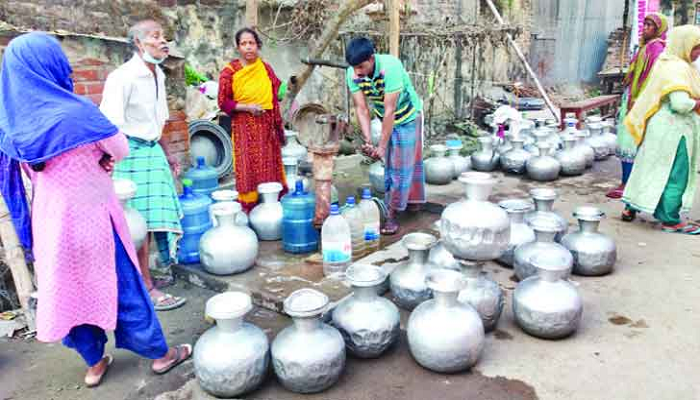
The Crime Desk: Residential high-rise buildings, commercial buildings, and industries are being built around the upazila Sadar area and the highway in Chittagong. There is no provision for service waiters. Groundwater is being used to meet the demand. Due to the reduction in open space, sufficient rainwater is not able to percolate underground. Reckless extraction of underground water is going on as there is no supervision by any agency to bring tube wells under the license. Thousands of tubewells in various areas of Chittagong have become useless due to the water level going down. Due to this, people have to suffer due to drinking water.
Chittagong City Corporation provides WASA service water in the area. But even though there is a service water system, underground water is being used by installing deep tube wells in every building in the city. Even though there is a regulatory body, legal action is not being taken. Experts say that initiative should be taken to provide service water in the municipal area of Upazila Sadar. Municipalities can take this initiative.
In Chittagong, there is no provision of service water anywhere except the City Corporation area. Recently, the implementation of two service water projects funded by the World Bank has been underway in Banskhali and Chandnaish Municipal Areas. Due to the expansion of industrialization and business, multi-story buildings are being constructed at a large rate in the upazila Sadar area of the district. In the Sadar area, there are various establishments, including small industries, hospital clinics, shopping centers, and residential multi-story buildings. But due to a lack of service water systems, underground water is being extracted for drinking and consumption through deep tube wells. But there is no obligation to obtain a license for tube wells for commercial use. It can be seen that there is a shortage of fresh water in different parts of the district during the dry season. In many areas, there is no water in the tube wells.
Professor of Chittagong University of Technology and Engineering. Sudeep Kumar Pal told the media that where there is no water supply in WASA, people are resorting to groundwater. Although there is a legal obligation to obtain a license for tube wells in municipal areas, people are not complying. Groundwater equivalents are reduced due to reduced open space, preventing rainwater from percolating underground. Municipalities can arrange service workers on their own initiative if they want.
According to the sources of the Directorate of Public Health and Engineering in Chittagong, the water level in Patia, Karnaphuli Upazila, Sitakundu, Mirsarai, Lohagara, and Anwara, along with the district, is decreasing rapidly. Deep tubewells in the Karnaphuli and Sitakundu areas are not getting water. As Deda underground water extraction is going on, people will have to suffer in the future due to drinking water. In a big industrial plant located in the district, three to four deep tube wells are being installed to extract water.
When asked, Palash Chandra Das, executive of Public Health Engineering, Chittagong, told the media, ‘Very little water is used for food. As a result, there is no loss of groundwater in these government tube wells. However, more groundwater is being used in agriculture and industries. It affects the water level. The government has taken the initiative of supplying water at the upazila level by purifying it through the project.
Experts say alternative sources should be considered to meet the demand for fresh water. We have sea, river, and canal water. Quick steps should be taken to use this water for purification. Otherwise, there will soon be an extreme shortage of fresh water in different parts of the country. If asked, the former VC of Chuet and chairman of the Chittagong WASA Board of Directors, Professor Dr. Jahangir Alam, told the media that due to the construction of paved buildings in the city and villages, the rainwater is being obstructed from entering the ground. Directly going to the river canal. We need to think about the use of surface water. The water at Inani Beach in Cox’s Bazar is very clear. If water is extracted and purified from there, it can be supplied to the entire south of Chittagong. Projects should be taken up on water purification for salinity. Seawater is being purified and used in various countries in the Middle East. Purification consumes more electricity. In this case, if you use electricity by installing solar panels, the cost will be much less.
Engineers of the Public Health Department said that the water level is going down by three to four feet every year. Where earlier water was available by going down 20 feet, now one has to go down 35 or 40 feet. 25 percent of the tube wells in the upazila have become useless.
Nazim Uddin Russell, assistant engineer of Karnaphuli Upazila, said that arsenic is found in tube wells with a depth of 100 to 150 feet. Several deep tubewells are installed in each of the factories. In some areas, drinking water is not available even after going very deep. Some areas have to go 500 to 600 feet deep. There is an extreme shortage of fresh water in Raipur, Dakshin Gahira, Purgahira, Sarenga, and North Paruapara of Anwara upazila. As the sea is coastal, the salinity of the water is high. Salt water enters the ponds during high tide.