



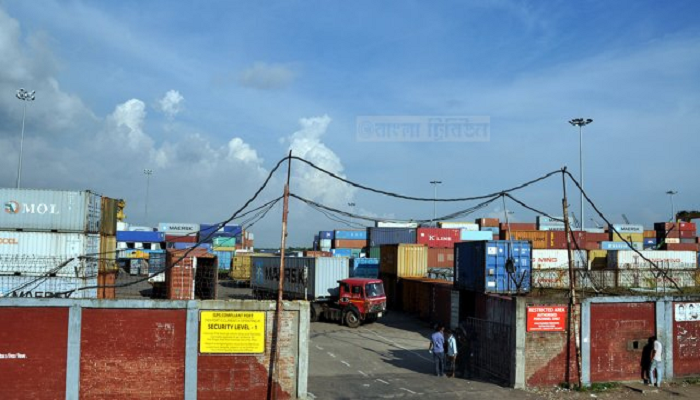
City Reporter: The Chittagong Customs Authority is not able to destroy 133 containers of hazardous chemical products that are unfit for auction and have been lying in different yards of the port for a long time. In this situation, Chittagong Customs wrote a letter to Chittagong Port about 10 months ago requesting the installation of an incinerator (a machine for burning waste at high temperatures). However, due to the lack of a promising response from Chittagong Port, these chemical products have become a huge burden for customs. In December 2020, 49 tons of various chemicals were destroyed in the geocycle project of Lafarge Holcim Cement Factory in Sunamganj.
According to Chittagong Customs sources, these chemicals on the destruction list include various types of solid substances: hydrogen peroxide, dithonite, sulphoxylate, hydrochloride, nitroglue solution, caustic soda, pharmaceutical ingredients, beverage concentrate, etc. The disposal of expired chemicals also requires compliance. While other expired products are usually destroyed by digging large holes in the ground with a scavenger, chemicals are different. Because chemicals destroy the quality of the soil. Therefore, according to the advice of the Department of Environment, chemicals have to be destroyed.
In the letter written to the Chittagong Port Chairman on April 26 last year requesting the installation of incinerators, it is mentioned that a committee was formed in light of the decision of the meeting held at Chittagong Port on July 28, 2022, under the chairmanship of the then Chief Secretary of the Prime Minister. A significant amount of dangerous goods have been destroyed in that context. But due to the non-availability of the necessary space and budget for the destruction of perishable goods in favor of custom houses, various challenges are being faced in carrying out demolition activities. In the past, an initiative was taken to destroy perishable goods in the dumping yard of Chittagong City Corporation, but it was not possible to implement it due to the lack of width of the road of the dumping yard for the movement of vehicles transporting containers. At present, demolition activities are being carried out on a limited scale in various privately owned places based on the agreement of the owner of the place with the vendor approved by Chittagong Customs for the demolition activities. Thus, a lot of time is spent on the overall preparation, including verifying the ownership of the demolition site and obtaining permission from the Department of Environment in privately owned areas. As a result, perishable goods cannot be destroyed in time. In addition, due to the lack of specific government sites and the inadequacy of necessary logistics and budget, demolition activities are currently being carried out in various private places, but some unscrupulous gangs have tried to dig up the destroyed products in the dark of night and sell them in the open market. In this list, there were many products that were banned from import. In this situation, there is no alternative to taking steps to permanently destroy harmful import-prohibited products and dangerous chemical products by burning them in incinerators. The allocation of a permanent site for demolition operations in favor of the Chittagong Customs Authority is a matter of time. Therefore, it is humbly requested that the Port Authority take the necessary administrative initiative to set up an incinerator for carrying out demolition activities at a convenient place until a permanent place is obtained in favor of Chittagong Customs.
If you want to know about this, Chittagong Custom House Commissioner Md. Faizur Rahman told the media that, due to a lack of space, we are unable to destroy 266 containers of ineligible products. Among them, 133 containers contain various types of dangerous chemical products. We have written to the Chittagong Port Authority about the installation of incinerators. Actually, we need a place of our own for product destruction.
It is to be noted that after the explosion of such chemical substances in Lebanon’s Beirut port on August 4, 2020, caused huge damage, the process of chemical destruction started in Chittagong port for a long time. At that time, a six-member investigation committee was formed to investigate the quantity of dangerous goods in the Chittagong port. The committee found stockpiles of 23 types of hazardous chemicals inside the port at that time.