


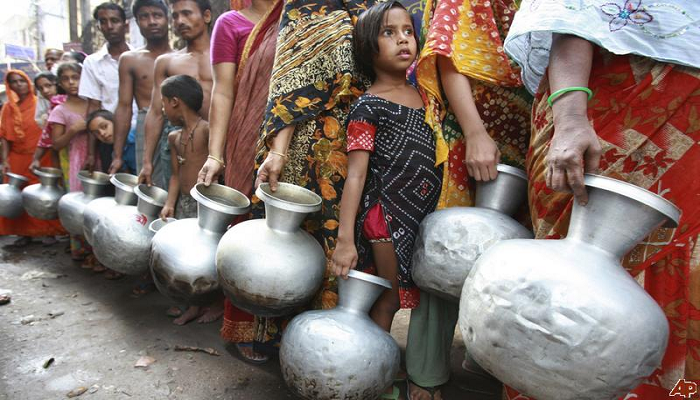
City Reporter: There is a shortage of water in different parts of the city before fasting. This crisis has arisen in the city due to a reduction in the production of WASA water. Many areas of the city are not getting water throughout the day. Water scarcity is more pronounced in higher areas.
Wasa officials said that the source of Wasa’s water is the Halda and Karnaphuli rivers. Water cannot be taken from the river during low tide as the water level has gone down. Again, salinity increases during high tide. WASA has no alternative source to overcome this problem. Now, water production has decreased by about 5 crore liters per day. A decision has been taken to provide water by rationing in the city. Wasa collects water from the Halda River for Sheikh Russell and Mohra water treatment plants at Madunaghat and from the Karnaphuli River for Sheikh Hasina water treatment plants 1 and 2 at Rangunia. But now the water level in two rivers has reduced. Water is not being released in Kaptai Lake due to a reduced water level. During high tide, salt water enters Halda. Again, if the water level in Halda and Karnaphuli falls during low tide, sufficient water cannot be collected. Due to these reasons, the water supply in Wasa is severely disrupted.
Kaptai Lake normally has a maximum water level of 109 feet. But now the water level has come down to 83 feet. One of the five units of the Kaptai hydroelectric power plant has been kept operational due to the decrease in the water level in the lake. Salinity has increased in Halda due to the non-release of water from Kaptai Lake.
Every year at this time, salinity rises in the Karnaphuli and Halda rivers. Then Wasa’s water production was severely disrupted. They say it is a natural problem. If there is no rain, there will be no relief from salinity. Due to this, the people of the city have to suffer due to the lack of drinking water. Those who have private tube wells can overcome the water shortage, but those who do not have tube wells are facing problems. Wasa officials said that during the tide, Haldar water has about 2000 milligrams of salinity per liter. And 250 mg of salinity per liter is considered suitable for drinking.
WASA Chief Engineer Maqsood Alam told the media that we have now decided to provide water by rationing. Water supply will be given every other day by dividing the area. Initiatives are being taken to re-open 45 deep tube wells to increase water production. Production and supply of water are being disrupted due to load shedding of electricity.
When asked about salinity in river water, Wasa Board of Directors Chairman Prof. Dr. Jahangir Alam told the media that the level of salinity will increase in the future. To remove salinity, a ‘Revarge Osnosis System’ can be installed in the river where the water is collected for the treatment plant. Then there will be no salt level in the water supplied at consumer level.